
At Pro House Demolitions Melbourne, we are leading demolition experts and a trusted demolition company, providing comprehensive demolition services and house demolition services across Melbourne and its surrounding suburbs. We specialise in residential and commercial demolition, delivering reliable services in Melbourne and nearby growth areas. We help homeowners across Melbourne move from an old house to a clean, build-ready site with clarity and control, ensuring a smooth transition that is ready for the next stage of construction.
In this 2026 step-by-step guide to house demolition in Melbourne, you will learn how the demolition process works from first inspection to final clearance certificate. By the end, you will know what to expect, what influences house demolition cost in Melbourne, and how to prepare for a smooth knock-down rebuild. If you are researching home demolition in Melbourne, property owners can rely on this guide to clarify the essentials before starting your demolition project in an efficient and hassle-free manner.
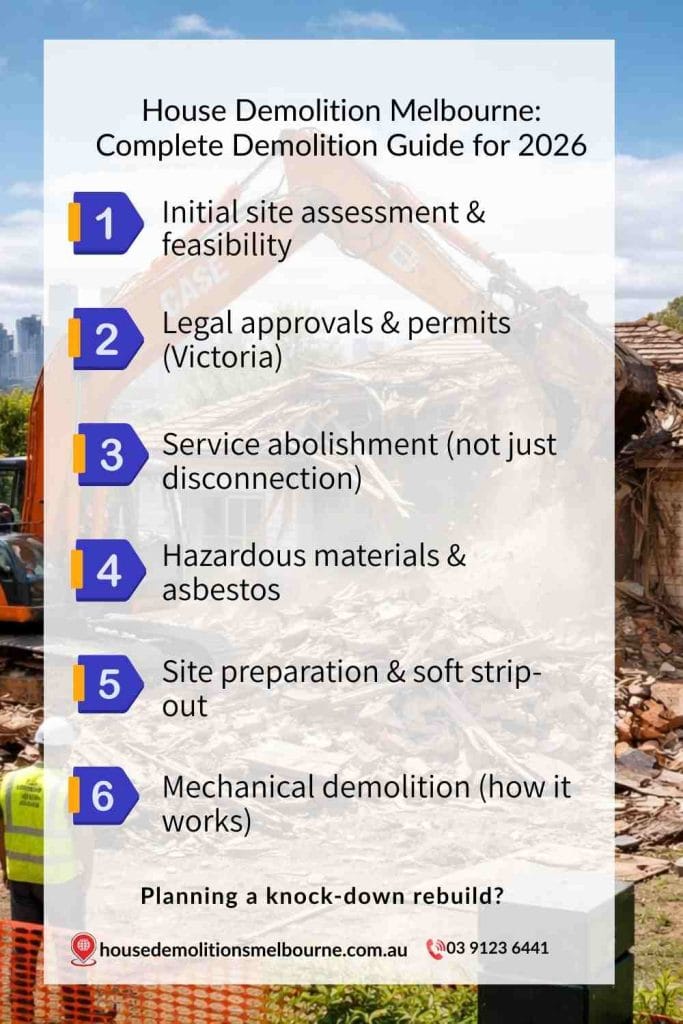
What is “complete house demolition”?
Complete house demolition is the full removal of an existing home’s walls, roof, slab, footings, and any attached sheds, followed by clearing and levelling the land to create a build-ready block. It is not a strip-out or partial demolition. The outcome is a clean, vacant site prepared for new construction.
This type of professional house demolition ensures every demolition is completed in compliance with Victorian regulations and strict safety standards, with structures dismantled in an environmentally responsible way to minimise landfill impact.
What Complete House Demolition Includes:
- External and internal walls
- Roofing materials and roof framing
- Concrete slab or timber stumps
- Footings and foundations
- Driveways and hardstand areas if required
- Detached garages, sheds, and outbuildings
- Site debris and construction waste, including full debris removal and sorting for recycling
The process ends with site clearing and basic levelling so builders can commence a knockdown rebuild project without obstruction and safely remove any remaining hazards before construction begins.
What Does House Demolition Cost and Timeline Look Like in 2026?
In Melbourne in 2026, full-house demolition typically costs $20,000 to $50,000+, with base rates around $50 to $100 per m². The complete process takes 3 to 8 weeks, while the physical machine demolition usually lasts 2 to 7 days. Final pricing depends heavily on asbestos presence, site access, including vehicle access limitations, permits, waste disposal, slab removal requirements, and whether additional excavation services are needed for basements or deep footings.
For larger office buildings, industrial complexes, or other large-scale structures, costs increase due to complexity and compliance obligations. These complex projects often require specialised commercial demolition services rather than standard residential works.
| Item | Typical range (2026) | Notes |
| Total cost | $20,000 – $50,000+ | Size, access and asbestos are big drivers |
| Cost per m² (base) | $50 – $100+ | Base only. Add multipliers for complexity |
| Full process time | 3 – 8 weeks | Includes permits, tests and clearance |
| Machine time on site | 2 – 7 days | Preparation and clean up take longer |
Step 1 — Initial site assessment & feasibility
Goal: find risks, access issues and likely costs before you sign anything.
What the inspector checks (short list)
- Building type (weatherboard, brick veneer, double brick).
- Roof and slab type (tiles, tin, slab, stumps, waffle pod).
- Access (driveway width, laneway, overhead wires).
- Trees and vegetation (protected trees may need permits).
- Heritage overlays (could stop full demolition).
- Signs of contamination or old tanks.
Why do this first? It sets the true price and avoids surprises. Hard things like asbestos, basements and poor access add time and cost.
Quick action: Book a site inspection and ask for a written feasibility note that lists the likely extras.
Step 2 — Legal approvals & permits (Victoria)
You must not start without the right approvals, and in most cases, a demolition permit is required before any structural work begins.
Main permits and checks
- Demolition permit (issued by a registered building surveyor). Mandatory in most cases.
- Section 29A heritage check — needed if the site may be in a heritage overlay.
- Asset protection permit (council) — protects footpaths, kerbs and nature strips. You may pay a bond.
- Neighbour notifications / Protection Works — required where works affect adjoining properties.
Documents typically needed for the demolition permit
- Proof of ownership and Certificate of Title.
- Site plan and any engineering details.
- Asbestos audit report.
Tip: Confirm council requirements early and ensure you obtain all necessary permits before scheduling works. Some councils ask for extra reports or higher bonds.
Step 3 — Service abolishment (not just disconnection)
Demolition needs services permanently removed from the block.
Live services during demolition work are dangerous and illegal, and contractors must handle abolishment correctly.
What must be abolished
- Electricity — removed at the pole or pit.
- Gas — capped at the mains.
- Water & sewer — capped by a licensed plumber.
- NBN / telecoms — returned to pit or pole as required.
Why this matters: live services during demolition are dangerous and illegal. Providers can take up to 20 business days to complete abolishment, so book early.
Proof required: keep written certificates from each provider for your building surveyor.
Step 4 — Hazardous materials & asbestos
If your home was built before 1990, assume asbestos may be present.
Must do
- Get a formal asbestos audit before demolition. Visual checks are not enough.
- If asbestos is found, removal must be done by a licensed asbestos removalist and a clearance certificate issued.
- Other hazards to check: lead paint, underground fuel tanks, contaminated soil.
Waste tracking: hazardous materials must be contained, transported by licensed carriers and tracked under EPA rules.
Why early testing helps: it lets you price correctly and keeps the project moving.
Step 5 — Site preparation & soft strip-out
Before heavy machinery arrives:
- Secure the site (cyclone fencing, signage).
- Soft strip: remove cabinets, fittings, plaster, appliances and anything salvageable.
- Inventory recyclables (bricks, hardwood, metals) to reduce landfill and tipping fees and help minimise environmental impact.
- Set up dust control (water misting) and neighbour notices to reduce disruption to the surrounding area.
Some sites may require preliminary excavation work before structural removal begins.
Step 6 — Mechanical demolition (how it works)
Most residential demolitions use machines like excavators (5–30 t) with hydraulic grabs and breakers.
Typical sequence
- Remove the roof and upper structures.
- Work down to the walls and the ground floor.
- Break and remove the slab and footings.
- Load and sort materials on site.
Slabs & footings: waffle pod or reinforced slabs are harder and cost more to remove. Basements add complexity.
Noise & vibration: works must comply with EPA limits and local council hours. In tight areas, you may need vibration monitoring.
Step 7 — Waste management & recycling
Modern demolition separates material to recycle and reduce landfill, particularly from older buildings constructed prior to modern environmental standards.
Common streams
- Concrete and masonry (often crushed and reused).
- Scrap metal.
- Timber (reusable hardwood).
- Hazardous waste (asbestos, oils) — tracked strictly.
Paperwork: keep weighbridge dockets, transfer receipts and chain-of-custody records for hazardous waste. EPA audits can happen.
Tip: Skip bins suit small jobs. Direct haulage suits large volumes. Always request a free waste assessment if unsure about likely disposal volumes.
Step 8 — Site levelling & handover
After waste removal:
- Remove footings and stumps.
- Bulk excavate or remove contaminated soil if needed.
- Backfill and compact in layers. Builders often ask for certified compaction.
- Final survey and updated geotechnical report if required.
Handover documents you should receive
- Demolition completion report (photographs, confirmations).
- Waste disposal receipts.
- Service abolishment certificates.
- Asbestos clearance certificate (if applicable).
- Building surveyor sign-off.
Keep these for at least seven years.
How demolition pricing works (2026)
In Melbourne in 2026, house demolition pricing usually starts at $50 to $100 per m² as a base rate. This base covers structural knockdown only. Final costs increase based on access, asbestos, slab type, council requirements, waste disposal, and site conditions.
Base range: $50–$100 per m² is a typical starting rate. This is ONLY a base.
Main cost drivers:
- Access: Narrow sites need smaller machines and extra traffic control.
- Asbestos: small bonded jobs $2k+, major friable asbestos can be $30k+.
- Slab type: waffle pod and reinforced slabs cost more.
- Double-storey / basements: more labour and time.
- Council costs: asset protection bonds, traffic plans.
- Contamination: soil remediation can add a lot.
Example (illustrative)
- 180 m² brick veneer house
- Base demolition: 180 × $65 = $11,700
- Asbestos: $8,000
- Waste & tipping: $6,000
- Permits & service fees: $3,500
- Service abolishment: $2,500
- Estimated total: ~$31,700
- Base demolition: 180 × $65 = $11,700
Budget tip: include a 10–15% contingency for surprises.
What Is the Difference Between Mechanical and Selective Demolition?
Mechanical demolition is fast and cost-efficient, typically used for full knockdown rebuild projects. Selective demolition is slower and 10 to 30 percent more expensive per m², used when parts of the structure must be retained, such as heritage facades or staged renovations.
| Factor | Mechanical | Selective |
| Speed | Fast (days) | Slower (weeks) |
| Cost | Lower per m² | 10–30% higher |
| Use case | Full knock-down rebuild | Heritage retention, staged works |
| Salvage | Lower recovery | Higher recovery |
Choose selectively only when you must keep parts of the structure.
Should You DIY a House Demolition or Hire a Professional?
In Melbourne in 2026, hiring a licensed demolition contractor is almost always the safer and more practical choice. DIY house demolition is legally complex, high-risk, and often not much cheaper once permits, asbestos compliance, waste disposal, and insurance exposure are considered.
Why not DIY
- Legal permits and licensed asbestos removal are needed.
- Insurance and public liability risks are high.
- Heavy equipment needs trained operators.
- Hidden costs (waste, council repairs) add up.
A licensed contractor ensures strict compliance with regulations and strict safety standards throughout the project.
Choosing a licensed demolition contractor — checklist
Before you sign:
- Ask for proof of registration and licences.
- Request certificates of insurance (public liability, workers comp).
- Get a clear scope of work that lists permits, asbestos, slab removal, waste, and service abolishment.
- Ask who manages liaison with the building surveyor and council.
- Check local experience in your suburb type (inner-city, growth corridor, coastal).
Red flag: very low quotes that omit asbestos or permit costs.
How Do Council Requirements Differ Across Melbourne?
Council demolition requirements in Melbourne vary by location. Inner city and heritage areas face tighter controls and higher bonds. Outer growth suburbs usually have easier access but larger slabs and reactive soils. Coastal or sloping sites often require additional engineering, drainage controls, and retaining wall assessments. Always confirm directly with your local council before budgeting.
General patterns (confirm with your council)
- Inner city/heritage areas: tight access, likely overlays, higher bonds.
- Outer growth areas: easier access, larger slabs, reactive clay soils.
- Coastal/sloping sites: retaining walls, drainage, and extra engineering needs.
Always check your local council early.
What Are the Most Common House Demolition Mistakes in Melbourne?
The most common house demolition mistakes in Melbourne are starting without a demolition permit, confusing service disconnection with abolishment, skipping asbestos testing, hiring unlicensed contractors, and ignoring heritage overlays. Each can trigger fines, stop work orders, costly rework, and serious rebuild delays.
- Starting without a demolition permit.
- Confusing disconnection with abolishment.
- Skipping an asbestos audit.
- Hiring unlicensed contractors.
- Ignoring council heritage overlays.
Each mistake can cause fines, stop-work orders or big delays.
How Long Does a Full House Demolition Take in Melbourne?
In Melbourne in 2026, a full house demolition typically takes 3 to 8 weeks from first inspection to a cleared, build-ready site. The actual machine demolition usually lasts only 2 to 7 days. The rest of the time involves permits, asbestos compliance, service abolishment, and council approvals.
Typical Demolition Timeline (2026)
| Stage | Typical Time |
| Inspection and asbestos audit | 1 week |
| Permits and service abolishment | 2 to 3 weeks |
| Asbestos removal if required | 1 week |
| Mechanical demolition | 2 to 7 days |
| Waste removal and levelling | 1 to 2 weeks |
Weather, council processing and contamination can extend these times.
What Should You Check Before Committing to a Demolition Contract?
Before signing a demolition contract in Melbourne, confirm your Certificate of Title, check planning overlays, arrange service abolishment, organise an asbestos audit if required, obtain a fully itemised written quote, and notify neighbours where protection works may apply.
Each step reduces legal, financial, and timeline risk.
1. Current Certificate of Title Obtained
Request a current Certificate of Title to confirm:
- Legal ownership
- Easements
- Covenants
- Restrictions on the land
Easements can affect demolition access, machinery placement, and future rebuild design.
2. Planning Overlays Checked
Confirm with your local Melbourne council whether the property has:
- Heritage Overlay
- Environmental Overlay
- Vegetation Protection Overlay
- Design and Development Overlay
If a Heritage Overlay applies, demolition approval may require planning permission or facade retention.
Failing to check overlays can lead to enforcement action and stop work orders.\
3. Service Abolishment Bookings Made
Disconnection is not enough. Most councils require full service abandonment before demolition begins.
Confirm bookings for:
- Electricity
- Gas
- Water
- NBN or telecommunications
Service abolishment timing can delay demolition permits if not arranged early.
4. Asbestos Audit Arranged (Pre 1990 Homes)
If the property was built before 1990, arrange a licensed asbestos inspection.
Common asbestos locations include:
- Eaves
- Bathroom sheeting
- Fencing
- Vinyl flooring
- Garage roofing
A written asbestos report protects you from mid-project cost variations and WorkSafe Victoria penalties.
5. Written, Itemised Quote With Permits and Waste Included
Your demolition quote should clearly list:
- Cost per square metre
- Demolition permit
- Building surveyor fees
- Asset Protection Permit
- Asbestos removal allowance
- Slab and footing removal
- Waste removal and tipping fees
- Site levelling
If these items are vague or missing, request clarification in writing.
Red flag: unusually low quotes that exclude asbestos or permit costs.
6. Neighbours Notified and Protection Works Considered
In dense Melbourne suburbs, you may need:
- Protection Works Notice
- Dilapidation report
- Temporary fencing
- Asset protection bond
Notifying neighbours early reduces disputes and protects you from damage claims.
What Hidden Demolition Costs Should You Watch For?
In Melbourne in 2026, the most common hidden demolition costs include asset protection bonds, traffic management, underground tank or contaminated soil removal, driveway reinstatement, and interim site security. Always allow a 10 to 15 percent contingency to manage variations.
- Asset protection bonds and council repair costs
- Traffic management and temporary line covers
- Underground tank or contaminated soil removal
- Driveway or crossover reinstatement
- Ongoing site security between demolition and build
Plan for variation. A 10–15% buffer is sensible.
Conclusion
Complete house demolition in Melbourne is a regulated process that includes permits, service abandonment, asbestos removal, waste management, and site levelling. When done correctly, it leaves a safe, compliant, build-ready block and protects your knock-down rebuild from costly delays and legal risk.
At Pro House Demolitions Melbourne, we specialise in residential demo and full structural removal projects, melbourne offering tailored solutions for homeowners planning rebuilds. We manage the entire process from first inspection to final clearance. Our experienced and skilled team handles permits, asbestos coordination, service abolishment, mechanical demolition, concrete removal, excavation, waste removal, and site levelling across Melbourne and surrounding suburbs.
If you are planning a complete house demolition in Melbourne, contact us today to request a free quote and expert guidance on your next project.
FAQs
1. How much will it cost to demolish my specific house in Melbourne?
Your house demolition cost in Melbourne will typically range between $20,000 and $50,000, depending on size, access, slab type, and asbestos. The exact figure depends on your block conditions. A site inspection allows accurate pricing and prevents hidden cost surprises later.
2. How long will my demolition take from inspection to a cleared site?
Complete house demolition in Melbourne usually takes three to eight weeks from inspection to build-ready handover. The machine work lasts days. Permits, service abolishment, and asbestos clearance take longer. Planning early keeps your knock-down rebuild on schedule.
3. Do I need a demolition permit or a Section 29A report for my property?
Yes, most Melbourne homes require a demolition permit, and some require a Section 29A heritage report. Requirements depend on overlays and council rules. Checking early avoids legal delays and ensures your demolition proceeds lawfully.
4. Is asbestos likely in my home, and how much will removal add to the cost?
If your home was built before 1990, asbestos is likely present. Removal can add $2,000 to $30,000, depending on type and quantity. A formal asbestos audit confirms risk and protects your health, budget, and timeline.
5. Does your quote include everything, or could there be hidden costs later?
A proper demolition quote should include permits, asbestos allowances, slab removal, waste fees, and service abolishment guidance. If items are missing, costs may rise later. Clear, detailed pricing protects you from variations and underquoting traps.


